



Future-Proof Choice: Why Semi-Trailers Will Dominate Transport for Decades
March 30, 2026
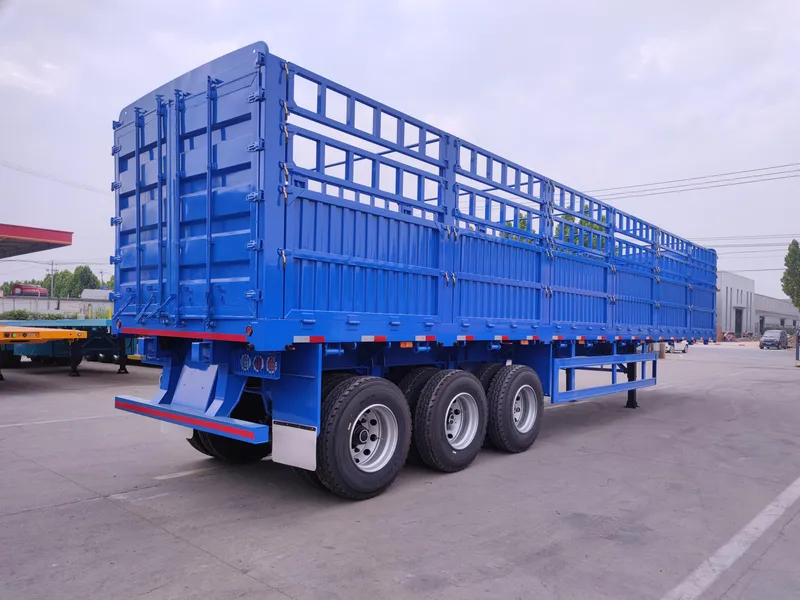
Semi-trailers are widely used in China’s transportation industry and play a vital role in modern logistics systems. Based on different cargo requirements, they can be classified into various types, including flatbed trailers, cage trailers, low-bed trailers, box trailers, tank trailers, container trailers, skeletal trailers, and more. These diversified configurations allow semi-trailers to meet most freight transportation needs efficiently.
What Is a Semi-Trailer and Why Is It Called So?
The term “semi-trailer” is derived from its unique structural design.
Unlike a full trailer, a semi-trailer does not support its entire weight independently. Its wheels are typically installed at the rear, and the front section must be connected to a tractor unit via a fifth wheel coupling system.
In this structure:
- The tractor provides forward traction
- The trailer shares part of the load
- Both units jointly bear the cargo weight
Because the trailer only carries part of the load and relies on the tractor for support, it is called a “semi-trailer.”
Semi-Trailer vs Full Trailer: Key Differences
To better understand semi-trailers, it is useful to compare them with full trailers.
A full trailer is equipped with wheels at both the front and rear of the chassis, allowing it to stand independently without support. When connected to a tractor, it is only linked through a towing device.
In this configuration:
- The tractor only provides pulling force
- The trailer bears the entire cargo weight
- No weight is transferred to the tractor
Therefore, full trailers are completely self-supporting in terms of load-bearing structure.
Emerging Trailer Types and Industry Development Trends
With continuous advancements in transportation technology, new vehicle types such as center-axle trailers and road trains have gradually entered the market. These models are often considered to offer potential advantages in regulatory support and loading efficiency.
However, this does not mean that semi-trailers are losing their relevance.
Why Semi-Trailers Remain the Mainstream Choice
1. Technical and Safety Limitations of New Models
Although center-axle trailers and road trains are gaining attention, they still face several practical limitations:
- Higher chassis design increases road condition requirements
- Poor stability on uneven or complex road surfaces
- Safety risks caused by inertia during emergency braking
- Increased difficulty in driving control (swaying, tail instability)
- High manufacturing and purchase costs
As a result, these models have not yet achieved large-scale market adoption.
2. China’s Transportation Environment
China has vast territory and complex terrain, with significant regional differences in road infrastructure.
This creates strong demand for vehicles that are:
- Highly adaptable
- Cost-efficient
- Easy to operate
- Suitable for diverse road conditions
At the same time, the freight market has remained relatively competitive, with generally low transport margins. Therefore, operators prefer vehicles with lower initial investment and broader cargo versatility.
In this context, semi-trailers continue to hold a strong advantage.
3. Global Market Perspective
In developed logistics markets such as Europe and the United States, transportation systems are highly standardized and advanced.
Current industry trends include:
- Lightweight vehicle design
- Standardization of components
- Specialized transport solutions
- Intelligent and remote monitoring systems
These developments are gradually influencing China’s logistics industry.
Notably, semi-trailers account for approximately 70%–80% of total freight transportation in Europe and North America, demonstrating their long-term stability and dominance in global logistics networks.
Conclusion
Despite the emergence of new trailer technologies, semi truck trailer for sale remain the backbone of modern freight transportation due to their balance of cost, stability, adaptability, and proven performance.
Given current market conditions and infrastructure realities, semi-trailers will continue to play a dominant role in China’s logistics industry for the foreseeable future.